
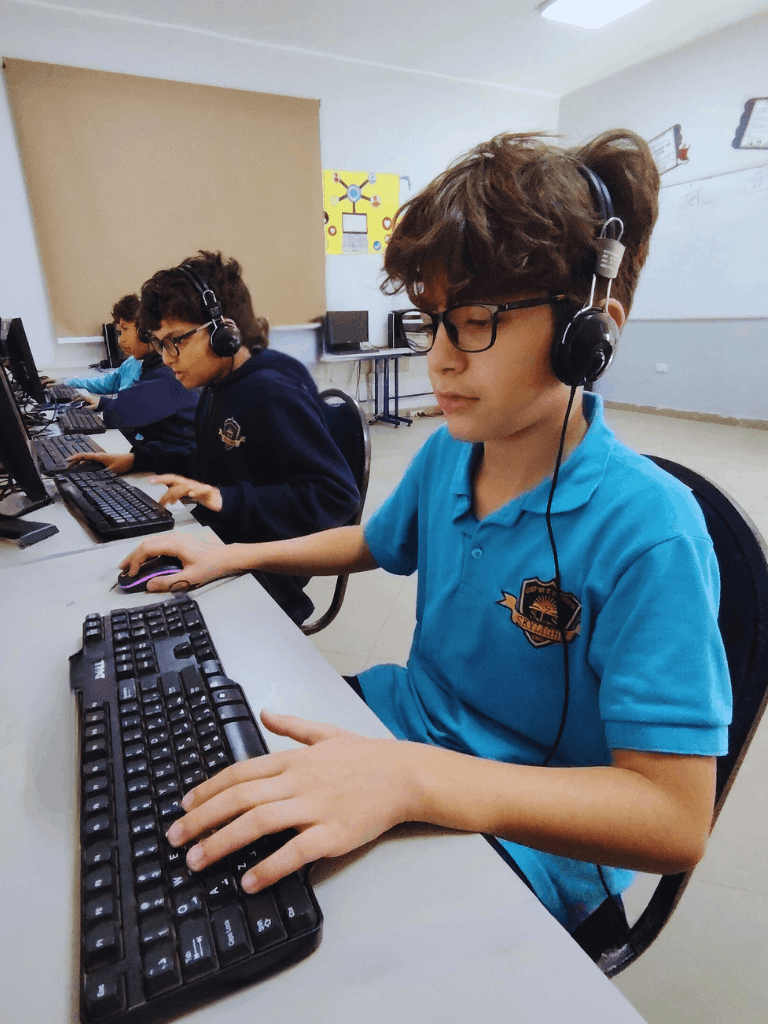
Screens are now a permanent part of children’s lives. From online lessons and educational apps to television, tablets, and smartphones, Egyptian children are growing up in a digital environment unlike any previous generation. This reality raises an important question for parents and educators alike: Does screen time support learning—or harm children’s cognitive development? Scientific research does not give a simple “yes” or “no.” Instead, it shows that the impact of screen time on learning depends on how, when, why, and how much screens are used. This article examines what neuroscience, psychology, and education research reveal about screen time and learning, with specific relevance to Egypt’s education system.
1. Understanding Screen Time in Modern Childhood What Counts as Screen Time? Screen time includes:
Educational videos and learning platforms
Online classes and digital homework
Gaming (educational and non-educational)
Social media and entertainment content
Passive viewing (TV, YouTube) and interactive use (apps, games)
Not all screen time is equal. Research consistently distinguishes between:
Passive screen use (watching without interaction)
Interactive and purposeful screen use (engaging, problem-solving, learning-focused)
2. Brain Development and Attention: What Science Shows The Developing Brain Children’s brains—especially under the age of 12—are still developing key cognitive systems, including:
Attention control
Working memory
Executive functions (planning, self-regulation, impulse control)
Neuroscience shows that attention is a limited resource. Rapid, highly stimulating screen content can train the brain to expect constant novelty, making it harder for children to:
Focus on sustained tasks
Read long texts
Follow complex instructions
Persist through academic challenges
This is particularly relevant in Egypt, where students are expected to concentrate for extended periods during lessons and exams.
3. Screen Time and Cognitive Development: What Research Reveals Potential Risks of Excessive Screen Time Large-scale studies indicate that excessive, unstructured screen time is associated with:
Reduced attention span
Delayed language development (especially in early childhood)
Weaker executive function skills
Increased distractibility
Lower academic performance when screen use replaces reading or active learning
For younger children, especially under age 6, heavy exposure to passive screen content has been linked to:
Slower vocabulary growth
Reduced parent-child interaction
Less imaginative play
These effects are not caused by screens alone—but by what screens replace (conversation, play, sleep, reading).
Potential Benefits When Screen Time Is Used Correctly Research also shows that high-quality, well-designed digital learning tools can:
Support literacy and numeracy development
Improve visual-spatial reasoning
Enhance problem-solving skills
Increase engagement when aligned with curriculum goals
Interactive educational content that requires thinking, decision-making, and feedback can support learning—especially when guided by adults.
4. Early Childhood Screen Exposure: A Sensitive Period Why the First 6 Years Matter Most During early childhood:
Language, attention, and emotional regulation systems are rapidly developing
Children learn best through human interaction, play, and sensory exploration
Scientific studies strongly recommend limiting screen time for young children and ensuring that:
Screens do not replace social interaction
Content is age-appropriate and educational
Adults co-view and discuss content with children
In Egypt, where early academic pressure may push digital learning too early, it is important to remember that screens should support development—not replace foundational learning experiences.
5. Screen Time and Academic Performance in School-Age Children The Relationship Is Not Linear Research shows a U-shaped relationship:
Very low or very high screen time is associated with weaker outcomes
Moderate, purposeful use can support learning
Problems arise when screen time:
Exceeds recommended limits
Interferes with sleep
Replaces homework, reading, or physical activity
Encourages multitasking during study
Multitasking with screens (e.g., studying while using a phone) has been shown to reduce:
Comprehension
Memory retention
Task completion accuracy
6. Screen Time, Sleep, and Learning Sleep is critical for memory consolidation and cognitive performance. Studies show that excessive screen use—especially before bedtime—can:
Delay sleep onset
Reduce sleep quality
Impair attention and memory the next day
In Egypt, where many students study late at night, screen exposure before sleep can worsen:
Exam performance
Concentration
Emotional regulation
Managing screen use in the evening is therefore a learning strategy, not just a health recommendation.
7. Digital Learning in the Egyptian Education Context Opportunities
Access to global educational resources
Support for blended and semi-international curricula
Exposure to interactive learning platforms
Skill development for digital literacy
Challenges
Overuse without guidance
Limited differentiation between educational and entertainment content
Reduced reading and handwriting practice
Parent uncertainty about appropriate limits
Effective digital learning requires intentional structure, not unrestricted access.
8. Evidence-Based Guidelines for Healthy Screen Use For Parents
Set clear daily limits for non-educational screen time
Encourage screen-free routines (meals, bedtime, reading time)
Co-view and discuss educational content
Prioritize sleep, reading, and physical activity
For Schools
Use screens to enhance—not replace—teaching
Avoid unnecessary screen exposure in early grades
Teach digital self-regulation skills
Integrate screen use with discussion, writing, and reflection
For Students
Use screens with a purpose
Avoid multitasking during study
Take regular breaks
Balance digital learning with offline activities
9. Balancing Technology and Learning: The Key Principle Scientific consensus does not call for eliminating screens. Instead, it emphasizes balance, quality, and context. Healthy cognitive development depends on:
Human interaction
Reading and writing
Play and physical movement
Sleep and emotional well-being
Screens can support learning—but they cannot replace these essentials.
10. Long-Term Implications for Lifelong Learning Children who learn to manage screen use effectively are more likely to:
Develop sustained attention
Engage deeply with academic material
Maintain healthy study habits
Use technology as a tool—not a distraction
These skills are crucial for higher education and future careers.
Conclusion: Screens Are Tools—Not Teachers The science is clear: Screen time itself is not the enemy. Unbalanced, unguided, and excessive screen use is. For Egypt’s education system, the goal should be:
Smart integration of technology
Age-appropriate digital learning
Strong foundations in reading, thinking, and human interaction
When screens are used intentionally and responsibly, they can enhance learning. When they dominate childhood, they can quietly undermine the very skills education seeks to build. The future of learning lies not in more screens—but in better choices about how we use them.